
Edisto Beach Criminal History Checks
Start close to the event. Edisto Beach town and court staff can identify a municipal case, ordinance summons, warrant, or local report custodian. The town does not publish one portal that joins all those records. If the event led to custody, the Colleton County Detention Center and Suite Pro become separate checks. Serious filed charges belong with the county Clerk of Court, while the South Carolina Law Enforcement Division holds the fingerprint-supported state record. Each source answers a different question, so a sound Edisto Beach records search uses the source tied to the record.
Use this order to avoid turning a civil or ordinance issue into an unsupported arrest claim:
- Call Edisto Beach town or Municipal Court staff to identify the local police, beach patrol, or court record.
- Ask for the incident report or ordinance-summons channel and give a date, place, and case number if known.
- Check the Municipal Court file for town ordinance, traffic, or adopted state matters.
- For an arrest, check Colleton County Suite Pro and then the court that received the filed charge.
- Use SLED CATCH only when a statewide, fingerprint-supported South Carolina history is the actual need.
Edisto Beach Court Records Since 1986
Edisto Beach Municipal Court dates to 1986, the same year the town built its Town Hall and fire station. That history matters because the court is not a county branch with a countywide file. It is a town court serving conduct within Edisto Beach limits. Its clerk maintains municipal cases and related papers, including original warrants and jail or bond paperwork when those documents arise. For older Edisto Beach court records, the clerk is the better first stop than a broad name search that may not cover the town docket.
The official Edisto Beach town site shows the local government setting where those town services meet. The town view below helps place the records counter in its actual municipal context.

A reader looking for Edisto Beach records should therefore ask whether the paper began with the town, even if later custody or prosecution took place elsewhere.
Records at the Edisto Beach Police Department
Town ordinances authorize an Edisto Beach police department and chief. Beach patrol may issue a Municipal Uniform Ordinance Summons. That summons is a local enforcement document, not automatic proof of an arrest or county booking. To locate the right Edisto Beach police record, contact the town at 843-869-2505 or use county nonemergency dispatch at 843-549-2211 to confirm which officer or agency created it. No separate official online town report portal was found in the research.
Provide a focused description. A date, street or beach access, type of event, name on the paper, and summons or case number can help staff locate an existing file. Ask which office keeps the narrative and whether any part is withheld or redacted. If county deputies handled the call, the Colleton County Sheriff's Office may be the custodian instead. That distinction saves time because the town cannot release a report it never created.
Note: A municipal summons can create an Edisto Beach court record without creating any county jail entry.
Edisto Beach Citations and Arrest Records
Beach, parking, golf-cart, and ordinance enforcement can lead to a citation that remains in Edisto Beach Municipal Court. A citation directs a person to answer a charge, but it does not by itself show physical custody. By contrast, an arrest can create an agency report, intake record, fingerprint event, and later court case. The distinction is vital in a resort town where a great deal of local enforcement involves use of public space rather than detention.
Compare the record types before drawing a conclusion:
| Edisto Beach record | Likely custodian | What it establishes |
|---|---|---|
| Ordinance summons | Town police or beach patrol and Municipal Court | A local allegation and required court response |
| Police narrative | Agency that handled the event | The reported facts and enforcement action |
| Booking entry | Colleton County detention staff | County custody, holds, and release data |
| Filed prosecution | Municipal Court or county Clerk | Charges, docket steps, and disposition |
None of the first three proves guilt. The outcome belongs in the final court file.
Booking and Arrest Records in Edisto Beach
No Edisto Beach town jail was identified. When local enforcement results in detention, use the official Colleton County Suite Pro inmate search and the jail phone, 843-549-5742, to test whether county intake occurred. Suite Pro can be searched by name, arrest date, held-for agency, custody date, release date, race, sex, or cell block. A current result may show hold or charge text, but that wording can change when a prosecutor files the case.
Do not assume every town incident reaches Suite Pro. A citation without arrest will not create a county booking. Fresh intake may also take time to appear, and another agency could control the report. Once a booking is found, identify the held-for or arresting agency and request the narrative from that custodian. Then look for the court disposition. The broader Colleton County arrest search routes explain county custody at more depth.
Seasonal Edisto Beach Record Demand
The Census Vintage 2025 estimate lists 1,071 Edisto Beach residents. That count does not measure the much larger visitor footprint during busy beach periods. Population is therefore a poor shortcut for the volume or kind of Edisto Beach police records. Seasonal traffic, parking, golf carts, beach use, and town-code enforcement can place nonresidents in the local record system without showing a broad crime trend among town residents.
Use the context with care. A municipal citation belongs to the person and event named in the court file. It should not be generalized into a claim about the community. Likewise, an Edisto Beach record search should use both the date and type of event. Those details help town staff separate a traffic or ordinance case from an arrest report, county booking, or General Sessions matter. The sharper the question, the less risk of mixing two people or two systems.
The Edisto Beach Municipal Court File
Edisto Beach Municipal Court serves the town limits. It hears ordinance offenses and matters ordinarily punishable by up to $500 or 30 days. Certain state matters can reach one year or $5,000 after a solicitor's petition and the defendant's agreement. The court can conduct bench or jury trials, issue arrest and search warrants, set bail, hold preliminary hearings, and punish contempt. It has no civil jurisdiction.
The official Edisto Beach Municipal Court page supplies the local court rules and access details shown in the captured court view below.
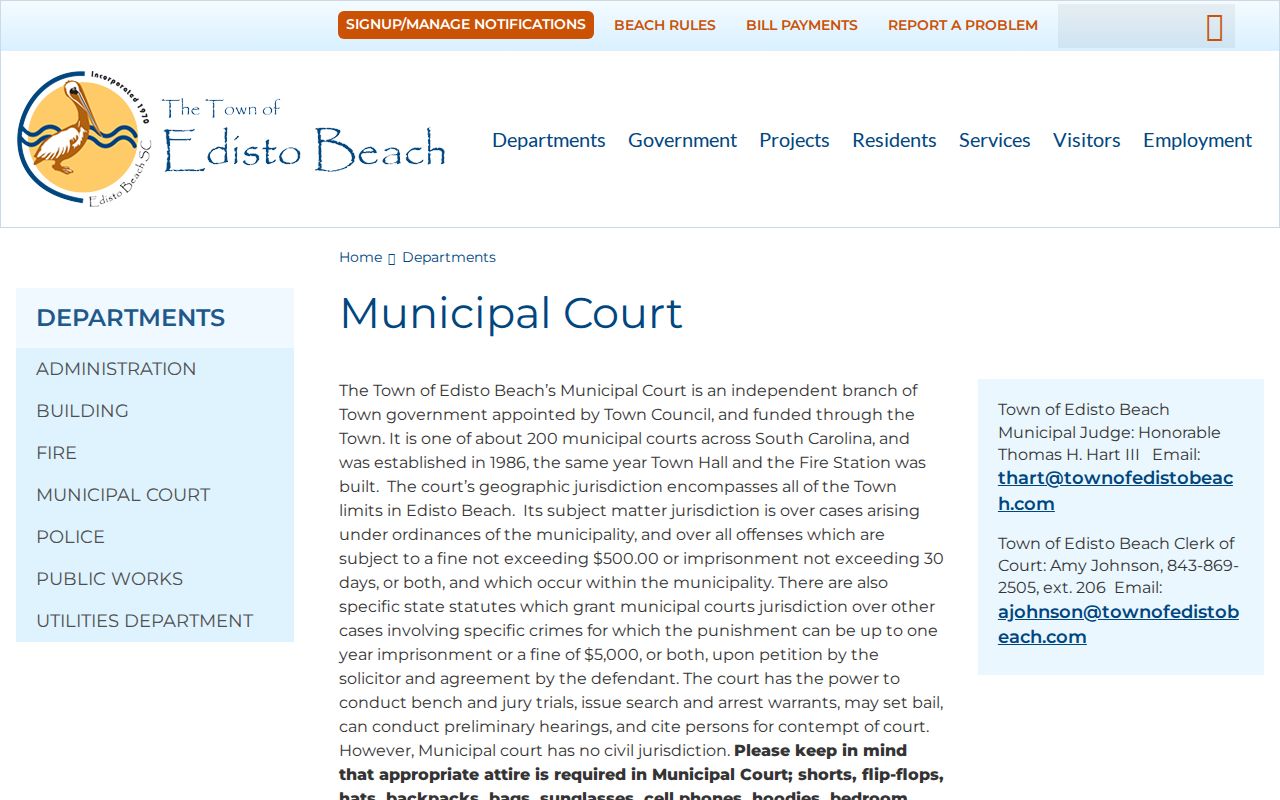
The image reinforces why the town court should be checked directly instead of assuming all Edisto Beach cases appear in the county index.
| Court | Edisto Beach Municipal Court, 2414 Murray Street |
|---|---|
| Case Types | Town ordinances, traffic, and authorized state criminal matters |
| Lookup | Clerk counter or phone at 843-869-2505; verify Public Index coverage |
| File Contents | Summons or warrant, case events, plea or trial, judgment, fine, and bond papers when applicable |
| Payments | Counter, mail, or online methods subject to the court's stated form and fee rules |
Edisto Beach Court Record Visits
The court counter accepts payments on weekdays from 8:30 a.m. to 4:30 p.m. Cash, certified check, and money order are accepted at the counter. Mailed payment must use a certified or cashier's check or money order. Online debit or credit payment carries a convenience fee. These payment routes concern an existing court matter. They are not a substitute for asking the clerk how to inspect or obtain an Edisto Beach court record.
Edisto Beach publishes strict courtroom entry rules. Shorts, flip-flops, hats, backpacks or bags, sunglasses, cellphones, hoodies, and bedroom shoes or slippers are barred. Ordinarily, only the defendant enters unless an officer allows another person. A person seeking records should call ahead and distinguish a counter visit from attendance in court. That small step avoids arriving with an item that the courtroom will not admit.
Note: Call the clerk before a record visit because courtroom access rules may differ from counter access.
How Edisto Beach Records Reach the County
A town event can produce several files at different times. Police or beach patrol creates the local report or summons. The Municipal Court keeps a town case. If custody occurs, Colleton County detention staff create the booking. A serious prosecution moves to the Circuit Court's Court of General Sessions, whose clerk keeps the filed case. Fingerprints and later dispositions may reach SLED for the state criminal-history cycle.
Record flow: Edisto Beach Police or Beach Patrol › Edisto Beach Municipal Court or Colleton County Courts › South Carolina Law Enforcement Division
The path is not automatic in every case. A parking or beach citation may stop at Municipal Court. An arrest could lead to county custody, yet the first charge label may not match the charge later filed. CATCH is a state history product, not a live town docket. For a full outcome, pair the first Edisto Beach record with the court that resolved it.
Missing Edisto Beach Arrest Records
An empty county portal result does not prove that no Edisto Beach event occurred. The matter may be a citation with no booking. Intake may be too new to display, the person may have been released or transferred, or another agency may hold the incident narrative. Municipal participation in the state Public Index should also be confirmed rather than assumed. Search failure is a prompt to identify the custodian, not a final finding.
Call the town or court at 843-869-2505 with the event date and any summons number. For possible custody, call the Colleton County Detention Center at 843-549-5742. If a serious case was filed, contact the Colleton County Clerk at 843-549-5791. For a statewide fingerprint-supported self-review, use SLED CATCH after checking the local court file. This fallback chain keeps Edisto Beach records in the right order and avoids treating silence from one database as an all-clear.
Edisto Beach Record Access Rules
The South Carolina Freedom of Information Act generally permits inspection, copying, or electronic transmission of existing public records. An office may charge actual search, retrieval, redaction, and reproduction costs and may seek a deposit. The law does not force Edisto Beach to create a new report or a custom database response. Active investigative facts, juvenile information, protected victim details, sealed cases, and facts covered by an expungement order can be withheld or redacted.
Current records usually receive an availability decision within ten business days. Records older than 24 months may receive a decision within twenty business days. Those are response rules, not a promise that every requested Edisto Beach police record is open.
Key Statutes:
South Carolina Freedom of Information Act, Section 30-4-30 gives the public a route to inspect or copy existing public records and sets response and fee rules.
South Carolina Code Section 30-4-40 allows protection of specified investigative, privacy, source, and safety information.
South Carolina Code Section 17-1-40 can require destruction of qualifying arrest and booking records after dismissal, discharge, or a not-guilty outcome.
Edisto Beach Court and Booking Records
When records disagree, compare what each office was built to record. The Edisto Beach court file tracks the legal case, including its charge, hearing, plea or trial, and final result. The county booking entry tracks custody, held-for agency, hold reason, and release. SLED CATCH tracks fingerprint-supported South Carolina arrest cycles and reported dispositions. A police narrative records the facts known to the responding agency. None is a full substitute for the others.
For personal review, save the summons or incident number and match it to the final court disposition. If an arrest was dismissed, discharged, or ended in a not-guilty result, South Carolina law may provide a route for destruction of qualifying arrest records, subject to limits. The deciding Municipal Court handles qualifying local dismissals, while other expungement matters generally run through the circuit solicitor. After an order, check that each relevant system has carried it out rather than relying on one missing search result.