
Colleton County Sex Offender Checks
The official Colleton County starting point is the free South Carolina Sex Offender Registry Tool, often called SORT. SLED maintains the statewide system while the Colleton County Sheriff's Office handles local registration and compliance work. Colleton County searchers may use a name when they know whom they seek. They may instead use an address, city, ZIP code, county, or map to examine a place. That second Colleton County route is often more useful for family safety and neighborhood awareness.
A registry lookup is separate from a general criminal-history check. SLED CATCH does not include registry status, and the court index does not serve as the current registry. Begin with SORT, then use the sheriff or SLED contact if a record seems stale. For an address near a county line or for a person who may have moved from another state, add the national search described later. Match photographs, aliases, offense details, and location rather than relying on a shared name.
Colleton Registry Gateway Conditions
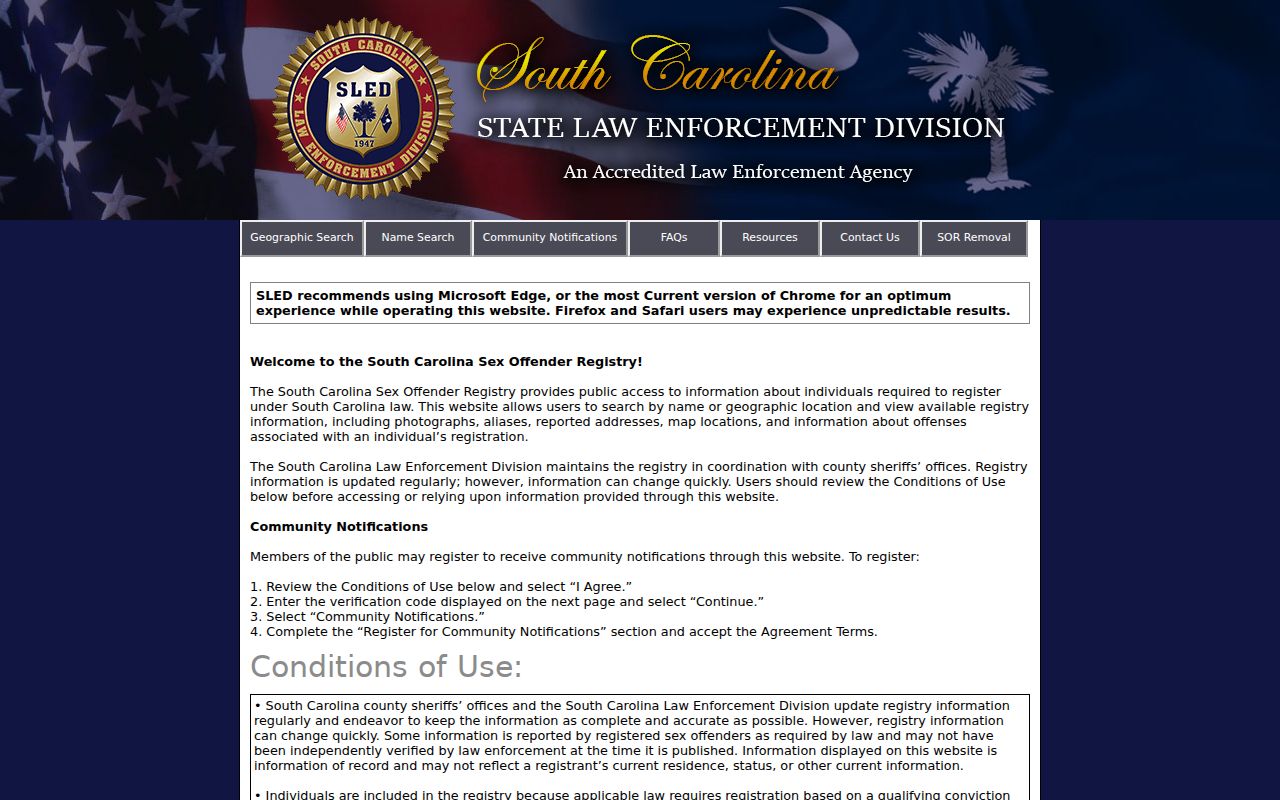
SORT puts its conditions page before each Colleton County search. The user must accept the terms and enter a verification code. That gate is purposeful. Colleton County registry facts can change fast, some details begin with information supplied by the registrant, and the listing must not be treated as a forecast of conduct. SLED also recommends a current version of Chrome or Edge because Firefox and Safari may not behave as expected.
The official SORT conditions gateway shows this entry step. The captured view below helps readers recognize the correct state page before submitting a Colleton County registry search.
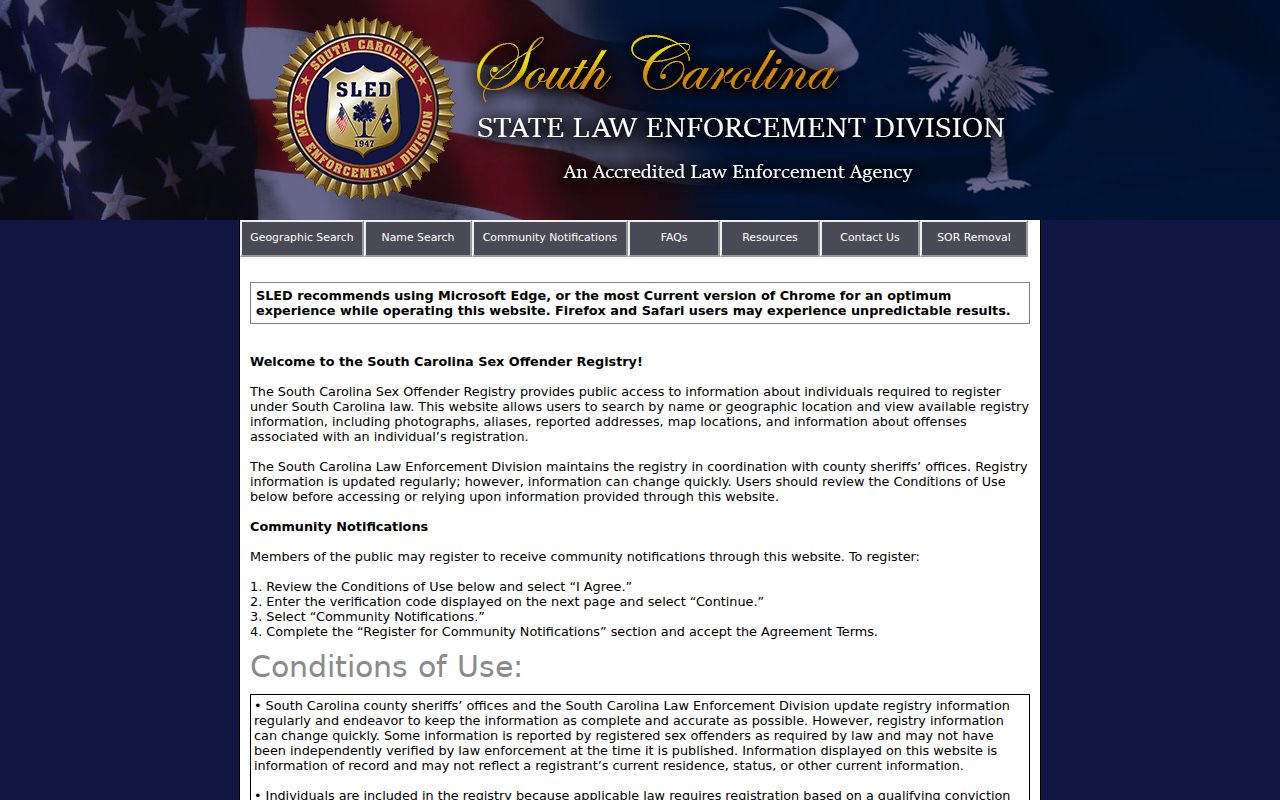
After accepting the terms, complete the code and choose the search tab that matches the question. If the gate rejects the code, refresh it and retry rather than using an unofficial copy of the data.
South Carolina Sex Offender Registry Searches
The public tool provides three distinct Colleton County routes: geographic search, name search, and Community Notifications. Exact radius choices sit behind the gate and can change, so they should be read live. For a Colleton County search, use the county selector or enter a known address, city, or ZIP code. A broad Colleton County map can reveal nearby reported residences, while a name search is better when an alias or identity is already known.
- Open the SLED registry gateway, read the accuracy and lawful-use terms, accept them, and complete the verification code.
- Choose Geographic Search for an area check or Name Search for a known person. Select Colleton when using the county filter.
- Review the result set and compare photographs, aliases, location, and qualifying offense information. Do not match on a name alone.
- Open the full profile, note the status and source details, and contact the sheriff or SLED when information appears wrong or out of date.
| Control | Type | Required | Use |
|---|---|---|---|
| Accept Conditions | Button | Yes | Confirms the user has read the registry warnings |
| Verification code | Text | Yes | Completes the gateway check |
| Geographic Search | Tab | No | Supports address, city, ZIP, county, map, and radius criteria |
| County | Select | No | Choose Colleton for a county-wide view |
| Name Search | Tab | No | Uses first and last name criteria |
| Community Notifications | Tab | No | Starts alert registration and its separate agreement |
The official geographic-search interface supplies the Colleton County filter and map view shown below.
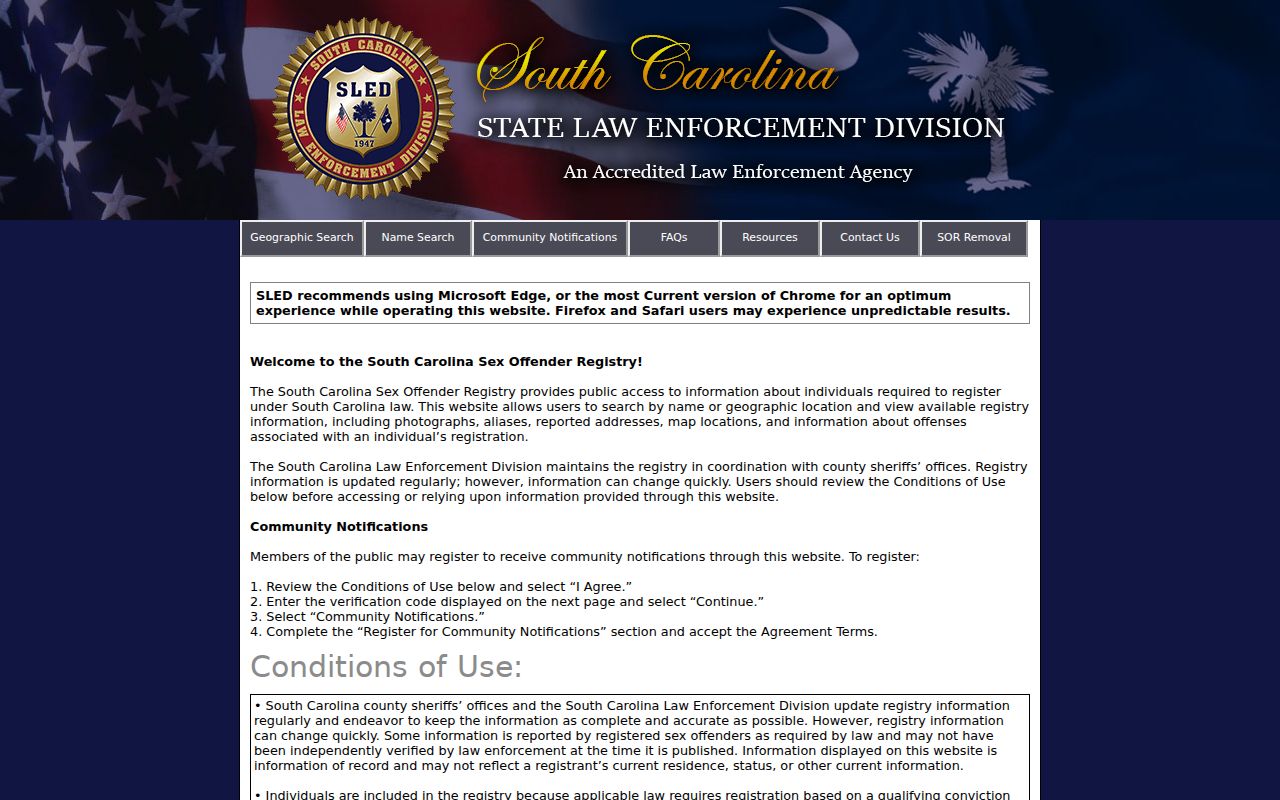
The map is a location tool, not a boundary survey or a real-time statement that a person is present at a pin. Read the underlying profile and its update details.
Registry Profiles: What They Show
A Colleton County SORT profile is built for identification and statutory notice. SLED says it verifies multiple photographs over time, aliases, a Colleton County residence map, and qualifying sex-related offenses. The live system may also display identity or status identifiers, a physical description, reported address, conviction date and jurisdiction, compliance information, distinguishing marks, or vehicles. Optional Colleton County fields depend on the record and current system display.
| Name and aliases | Reported identity and alternate names used to distinguish similar people |
|---|---|
| Photographs | Multiple images over time may help confirm the correct profile |
| Residence map | Reported address and geographic context, subject to update lag |
| Qualifying offenses | Sex-related conviction information that triggered registration |
| Status details | Registration or compliance information when the live profile provides it |
| Other identifiers | Physical traits, marks, vehicles, or jurisdiction details when shown |
The official SORT name-search screen provides the name route shown in this Colleton County registry image.
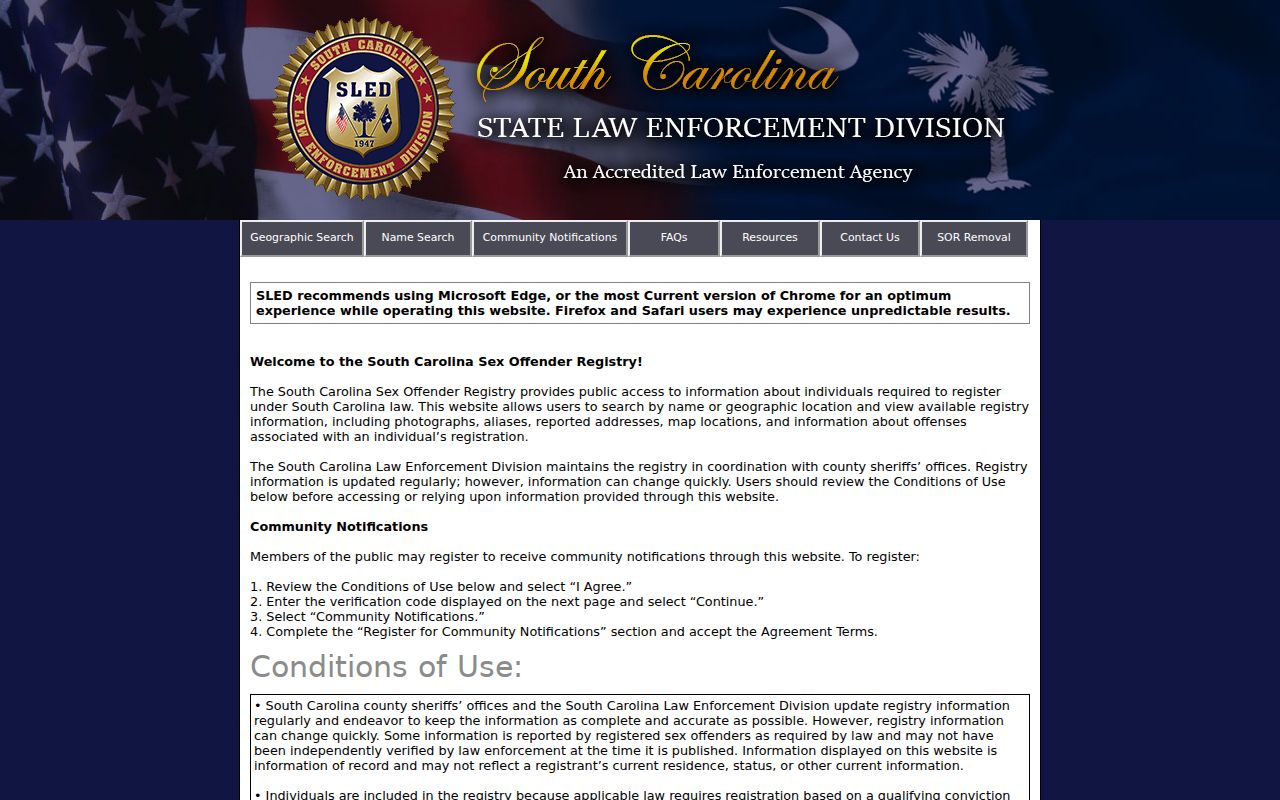
A result should be opened and checked as a whole. A name-only similarity does not establish that the profile concerns the person the searcher had in mind.
Colleton Registry and NSOPW
SORT is the primary source for South Carolina registry details and local Colleton County filters. The Dru Sjodin National Sex Offender Public Website, or NSOPW, adds a cross-state layer to a Colleton County check. It is useful when someone may have moved, when a Colleton County address sits near a state boundary, or when a family wants broad geographic awareness. NSOPW searches participating jurisdictions rather than replacing the records each state publishes.
Use both in sequence. Start with SORT for the state's current profile structure, community notification route, and Colleton County selection. Add NSOPW for a wider scan. If the two views differ, contact the state or county office that maintains the source record. A difference can reflect timing, jurisdiction rules, or an update still moving between systems. Absence from one interface is not proof that no registration duty exists elsewhere.
Registration Levels and Duties in South Carolina
South Carolina uses tier-based review points for Colleton County registry records. These are earliest times at which an eligible registrant may apply for removal. They are not automatic end dates. Colleton County registration continues unless and until the person receives written removal notice through the proper statutory route. Adult Tier I and II applicants generally apply to SLED, while a Colleton County Adult Tier III request proceeds by motion in General Sessions. Juvenile and out-of-state or federal records follow separate criteria.
| Category | Earliest application point | Route |
|---|---|---|
| Adult Tier I | 15 years from the applicable discharge or termination point | Paper application to SLED |
| Adult Tier II | 25 years | Paper application to SLED |
| Adult Tier III | 30 years | General Sessions motion |
| Out-of-state or federal | Equivalent SORNA or originating-law rules | Statutory route by equivalent tier |
| Juvenile | Separate tier and adjudication criteria | SLED or Family Court |
The SLED registry overview explains the statewide system, tiers, and removal framework illustrated below.
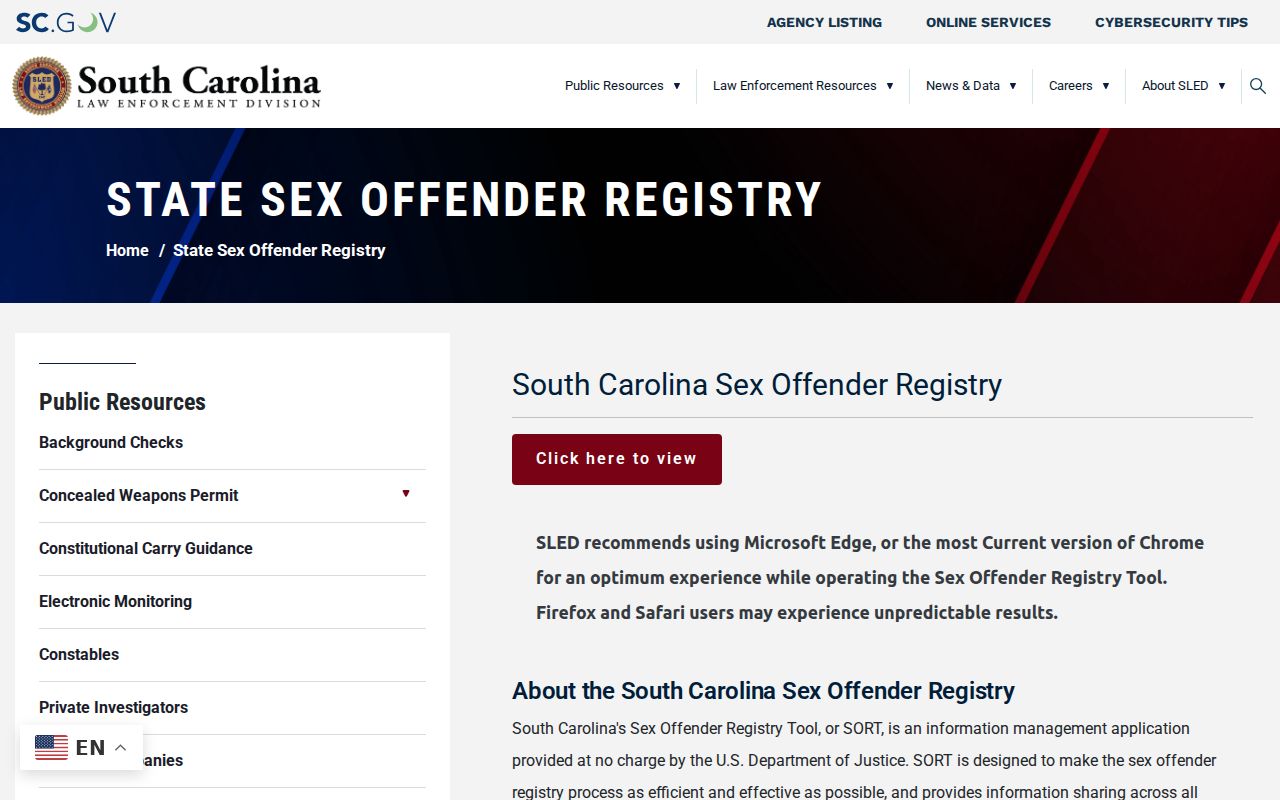
The state overview is the right place to check current packet instructions before sending money, fingerprints, or court papers.
Colleton Registry Removal Review Points
A Colleton County eligibility date only opens a possible application route. It does not clear the Colleton County public profile on that date. Tier I, Tier II, and eligible juvenile packets require a completed application, two recent FD-258 fingerprint cards, a $250 nonrefundable cashier's check or money order, sentencing or disposition records, and proof of required treatment completion. Colleton County applicants must also satisfy the conditions concerning recent failure-to-register conduct and new sexual offenses.
Packets go to the SLED SOR Unit at P.O. Box 21398, Columbia, SC 29221. SLED notifies the prosecutor. The statute describes a 120-day removal and notice process for verified, unopposed applications. A denial generally leads to court review, not an internal appeal, and usually requires five years before reapplication. Anyone tracing an old Colleton County case should obtain the court disposition first because the registry route is distinct from criminal-record expungement.
Note: A tier review point permits an application; only written removal notice ends a continuing South Carolina registration duty.
Using Registry Information Lawfully
Colleton County registry access supports personal and family safety, neighborhood awareness, and informed contact with public agencies. Community Notifications allow a Colleton County user to register for updates after accepting terms, entering the verification code, supplying the requested registration fields, and agreeing to the notice conditions. SLED states that Colleton County residents enrolled in the predecessor service must enroll again in the current system.
The official Community Notifications page is the source for the alert enrollment view below.
Alerts are a prompt to review the official profile. They do not replace a current check of the address, status, and qualifying offense information.
Use registry data lawfully: S.C. Code §23-3-510 adds punishment when registry information is used to commit another crime, including up to $1,000 and six months for a misdemeanor or up to five years for a felony. Do not injure, harass, threaten, or commit a crime against a registrant or anyone at a reported address.
Report Colleton Registry Concerns
If a Colleton County profile appears inaccurate, record the page, field, and reason for concern. Then contact the Colleton County Sheriff's Office registry coordinator at 843-549-2211 or SLED at 803-896-2601 and sor@sled.sc.gov. For suspected Colleton County noncompliance, give the agency specific observations without approaching the person or household. Officials can compare Colleton County registration files with the public view and decide what follow-up is warranted.
No county-specific residence-distance ordinance was found in the official research. Do not assume a universal distance rule from a map pin. Current requirements come from South Carolina Title 23 and any valid local code that applies. A registry listing also is not a present threat assessment. It shows a statutory registration record tied to a qualifying conviction, while risk and compliance questions require current facts from the responsible agency.